
Международный эндокринологический журнал Том 22, №7, 2026
Вернуться к номеру
Оцінка біомаркерів кісткового метаболізму в жінок похилого віку з остеопорозом
Авторы: Sabreen Malik Nayef, Faris S. Kata
College of Education for Pure Science, University of Basrah, Basrah, Iraq
Рубрики: Эндокринология
Разделы: Клинические исследования
Версия для печати
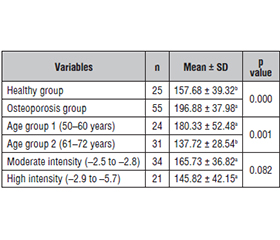
Актуальність. Остеопороз є дуже поширеним захворюванням, що характеризується прихованим ослабленням скелетної системи, внаслідок чого вона втрачає міцність і жорсткість. Це один із найважливіших розладів, пов’язаних зі старінням. Кістки стають крихкими й слабкими, а їх функціональна здатність знижується. Оскільки остеопороз часто перебігає безсимптомно, використання біомаркерів дозволяє точно оцінити динаміку стану кісткової тканини та визначити, чи є ремоделювання кісток нормальним або патологічним. Метa: вивчити метаболічні біомаркери (склеростин, остеокальцин та N-термінальний пропептид проколагену 1-го типу) у жінок похилого віку з остеопорозом. Матеріали та методи. У дослідження було залучено 80 пацієнток у постменопаузі, які перебували під спостереженням в медичному закладі Ibn Al-Bitar Private Hospital (мухафаза Басра, Ірак). Їх розподілили на дві групи: у першу ввійшли 55 хворих з діагностованим остеопорозом, а групу здорових осіб становили 25 жінок без остеопорозу. Учасниць було додатково розподілено на групи залежно від віку й тяжкості захворювання. Для оцінки мінеральної щільності кісткової тканини використовували метод двохенергетичної рентгенівської абсорбціометрії. Результати. Статистичний аналіз виявив вірогідне підвищення концентрації всіх досліджуваних біомаркерів (р < 0,000 ) у групі остеопорозу порівняно зі здоровими жінками. На підставі отриманих даних можна припустити, що в пацієнток із постменопаузальним остеопорозом спостерігається структурний дисбаланс кісткової тканини, якщо рівні маркерів ремоделювання кістки й остеопорозу в крові суттєво підвищені. Висновки. Результати дослідження свідчать про те, що виражене зростання катаболічних та анаболічних показників у сироватці крові жінок із постменопаузальним остеопорозом може вказувати на структурний дисбаланс кісткової тканини. Це може сприяти їх впровадженню як ефективних інструментів моніторингу метаболічних змін у пацієнток з остеопорозом та як допоміжних інструментів для ведення цього захворювання.
Background. Osteoporosis is a very common disease characterized by a silent weakening of the skeletal system, causing it to lose its strength and rigidity. It is one of the most important disorders associated with ageing. Bone becomes brittle and weak until its capacity declines. Because osteoporosis is often a silent disease, the use of biomarkers accurately reflects bone dynamics and indicates whether bone turnover is normal or pathological. The purpose of the study was to study metabolic biomarkers (sclerostin, osteocalcin and amino-terminal propeptide of procollagen type 1) in elderly women with osteoporosis. Materials and methods. This study included 80 postmenopausal women attending Ibn Al-Bitar Private Hospital in Basrah Governorate. Two groups were formed: the first group consisted of 55 serum samples from women diagnosed with osteoporosis, and the healthy group comprised 25 serum samples from women without osteoporosis. Patient samples were further divided into two groups based on age and disease severity. A dual-energy X-ray absorptiometry scan was used to estimate bone mineral density. Results. The statistical analysis indicated a significant increase in the concentration of all studied biomarkers at the probability level (p < 0.000) in the group with osteoporosis compared to the group of healthy women. Based on our findings, patients with postmenopausal osteoporosis may be experiencing a structural bone imbalance if their blood levels of bone remodelling and osteoporosis markers are considerably high. Conclusions. We conclude from the current study that the marked increase in catabolic and anabolic indicators in the blood serum of women who have postmenopausal osteoporosis may indicate a structural imbalance in the bone. This may help in the possibility of adopting them as effective indicators for monitoring metabolic changes in women with osteoporosis and as supportive tools for disease management.
остеопороз; склеростин; остеокальцин; N-термінальний пропептид проколагену 1-го типу; маркери метаболізму кісткової тканини
osteoporosis; sclerostin; osteocalcin; amino-terminal procollagen type 1 propeptide; bone metabolic markers
Для ознакомления с полным содержанием статьи необходимо оформить подписку на журнал.
- Özmen S, Kurt S, Timur HT, Yavuz O, Kula H, Demir AY, Balcı A. Prevalence and Risk Factors of Osteoporosis: A Cross-Sectional Study in a Tertiary Center. Medicina (Kaunas). 2024 Dec 23;60(12):2109. doi: 10.3390/medicina60122109.
- Seemann LL, Hanos CT, Pujalte GGA. Metabolic Bone Disease. Prim Care. 2024 Sep;51(3):445-454. doi: 10.1016/j.pop.2024.04.005.
- Gooch C, Ekert P, Gottesman GS. Metabolic Bone Disease: An Overview. Mo Med. 2024 Jul-Aug;121(4):297-303.
- Lundberg HE, Kafel J, Holo H, Larsen SE. Daily cheese intake positively affects serum osteocalcin levels, vitamin K status and bone turnover markers in elderly men and women. BMJ Nutr Prev Health. 2025 Aug 28;8(2):e000933. doi: 10.1136/bmjnph-2024-000933.
- Nowicki JK, Jakubowska-Pietkiewicz E. Serum Osteocalcin in Pediatric Osteogenesis Imperfecta: Impact of Disease Type and Bis–phosphonate Therapy. Int J Mol Sci. 2025 Aug 18;26(16):7953. doi: 10.3390/ijms26167953.
- Bhattoa HP, Vasikaran S, Trifonidi I, Kapoula G, Lombardi G, Jørgensen NR, et al. Update on the role of bone turnover markers in the diagnosis and management of osteoporosis: a consensus paper from The European Society for Clinical and Economic Aspects of Osteoporosis, Osteoarthritis and Musculoskeletal Diseases (ESCEO), International Osteoporosis Foundation (IOF), and International Federation of Clinical Chemistry and Laboratory Medicine (IFCC). Osteoporos Int. 2025 Apr;36(4):579-608. doi: 10.1007/s00198-025-07422-3.
- Wu S, Wang L, Zhang X, Cai L, Ke Q, Xu J. Bone turnover markers (β-CTX, PINP, ALP) in osteoporosis: correlation with bone loss and fracture risk stratification. Front Endocrinol (Lausanne). 2026 Jan 5;16:1628434. doi: 10.3389/fendo.2025.1628434.
- Carvalho FR, Gavaia PJ. Enhancing osteoporosis risk prediction using machine learning: A holistic approach integrating biomarkers and clinical data. Comput Biol Med. 2025 Jun;192(Pt B):110289. doi: 10.1016/j.compbiomed.2025.110289.
- Chen L, Wang Q, Gu M. Assessment of the efficacy and safety of anti-sclerostin antibody therapy for osteoporosis in postmenopausal women: a systematic review and meta-analysis of randomized controlled trials. Front Endocrinol (Lausanne). 2026 Jan 19;16:1732708. doi: 10.3389/fendo.2025.1732708.
- Iwamoto R, Koide M, Udagawa N, Kobayashi Y. Positive and Negative Regulators of Sclerostin Expression. Int J Mol Sci. 2022 Apr 28;23(9):4895. doi: 10.3390/ijms23094895.
- Komori T. What is the function of osteocalcin? J Oral Biosci. 2020 Sep;62(3):223-227. doi: 10.1016/j.job.2020.05.004.
- Manolagas SC. Osteocalcin promotes bone mineralization but is not a hormone. PLoS Genet. 2020 Jun 2;16(6):e1008714. doi: 10.1371/journal.pgen.1008714.
- Ami D, Santambrogio C, Vertemara J, Bovio F, Santisteban-Veiga A, Sabín J, et al. The Landscape of Osteocalcin Proteoforms Reveals Distinct Structural and Functional Roles of Its Carbo–xylation Sites. J Am Chem Soc. 2024 Oct 9;146(40):27755-27769. doi: 10.1021/jacs.4c09732.
- Naomi R, Ridzuan PM, Bahari H. Current Insights into Collagen Type I. Polymers (Basel). 2021 Aug 9;13(16):2642. doi: 10.3390/polym13162642.
- Andersen T, Ueland T, Aukrust P, Nilsen DWT, Grundt H, Staines H, et al. Procollagen type 1 N-terminal propeptide is associated with adverse outcome in acute chest pain of suspected coronary origin. Front Cardiovasc Med. 2023 Sep 4;10:1191055. doi: 10.3389/fcvm.2023.1191055.
- Jain SP, Ikkurthy N, Sundara S, Jain SP. Procollagen I carboxy-terminal propeptide: a multi-faceted biomarker. Biochem Med (Zagreb). 2026 Jun 15;36(2):020502. doi: 10.11613/BM.2026.020502.
- Huang J, Ma T, Wang C, Wang Z, Wang X, Hua B, et al. SOST/Sclerostin impairs the osteogenesis and angiogesis in glucocorticoid-associated osteonecrosis of femoral head. Mol Med. 2024 Sep 28;30(1):167. doi: 10.1186/s10020-024-00933-5.
- Katchkovsky S, Meiri R, Lacham-Hartman S, Orenstein Y, Levaot N, Papo N. Mapping the sclerostin-LRP4 binding interface identifies critical interaction hotspots in loops 1 and 3 of sclerostin. FEBS Lett. 2025 Feb;599(3):316-329. doi: 10.1002/1873-3468.15033.
- Li W, Wang W, Zhang M, Chen Q, Li F, Li S. Association of serum sclerostin levels with marrow adiposity in postmenopausal women with glucocorticoid-induced osteoporosis. BMC Endocr Disord. 2024 Apr 28;24(1):55. doi: 10.1186/s12902-024-01591-8.
- Szudy-Szczyrek A, Mlak R, Pigoń-Zając D, Krupski W, Mazurek M, Tomczak A, et al. Role of sclerostin in mastocytosis bone disease. Sci Rep. 2025 Jan 2;15(1):161. doi: 10.1038/s41598-024-83851-0.
- Oniszczuk A, Kaczmarek A, Kaczmarek M, Ciałowicz M, Arslan E, Silva AF, et al. Sclerostin as a biomarker of physical exercise in osteoporosis: A narrative review. Front Endocrinol (Lausanne). 2022 Dec 5;13:954895. doi: 10.3389/fendo.2022.954895.
- Liu S, Pang Q, Guan W, Yu F, Wang O, Li M, et al. Association of serum osteocalcin with bone microarchitecture and muscle mass in Beijing community-dwelling postmenopausal women. Endocrine. 2024 Apr;84(1):236-44. doi: 10.1007/s12020-023-03668-1.
- Tsaryk I, Pashkovska N, Pankiv V, Pashkovskyy V, Stankova N. Features of Anxiety and Depression Indicators in Patients With Autoimmune Diabetes Mellitus on the Background of Different Vitamin D Status. Romanian Journal of Diabetes Nutrition and Metabolic Diseases. 2025;32(2):203-209. doi: 10.46389/rjd-2025-1873.
- García-Rojas MD, Palma-Cordero G, Martínez-Ramírez CO, Ponce de León-Suárez V, Valdés-Flores M, Castro-Hernández C, et al. Association of Polymorphisms in Estrogen Receptor Genes (ESR1 and ESR2) with Osteoporosis and Fracture — Involvement of Comorbidities and Epistasis. DNA Cell Biol. 2022 Apr;41(4):437-446. doi: 10.1089/dna.2021.1165.
- Tidd MM, Swanson CM. Bone turnover marker rhythmicity: implications for osteoporosis treatment and fracture healing. Endocr Connect. 2026 Jun 26;15(6):e260114. doi: 10.1530/EC-26-0114.
- Alber CS, Halsey J, Emberson J, Hin H, Hill M, Armitage J, Clarke RJ. Effects of vitamin D on biochemical markers of osteoporosis: a meta-analysis of randomised trials. Br J Nutr. 2026 Apr 27:1-8. doi: 10.1017/S0007114526107193.
- Li W, Wang Y, Dong J, Di R, Liu X, Liu S. Age- and sex-specific differences in the association of serum osteocalcin and cardiometa–bolic risk factors in type 2 diabetes. Diabetol Metab Syndr. 2023 Mar 16;15(1):48. doi: 10.1186/s13098-023-01021-0.
- Tacey A, Sim M, Smith C, Woessner MN, Byrnes E, Lewis JR, et al. Association between Circulating Osteocalcin and Cardiometabolic Risk Factors following a 4-Week Leafy Green Vitamin K-Rich Diet. Ann Nutr Metab. 2020;76(5):361-367. doi: 10.1159/000511660.
- Chi PJ, Hung SY, Hsiao FT, Liou HH, Tsai JP. Serum osteocalcin concentration as an independent biomarker of osteoporosis in patients with chronic kidney disease. Clin Nephrol. 2022 Jul;98(1):1-9. doi: 10.5414/CN110705.
- Hu T, Shen Y, Xu Y, Wang Y, Bao Y, Ma X. Low total osteocalcin levels are associated with the risk of cardiovascular events among women with hyperglycaemia: a 7.6-year prospective study. Endocrine. 2023 Oct;82(1):47-56. doi: 10.1007/s12020-023-03428-1.
- Yoo JI, Park AJ, Lim YK, Kweon OJ, Choi JH, Do JH, et al. Age-related Reference Intervals for Total Collagen-I-N-terminal Propeptide in Healthy Korean Population. J Bone Metab. 2018 Nov;25(4):235-241. doi: 10.11005/jbm.2018.25.4.235.
- Kaneko H, Hasegawa D, Itoyama T, Yoshida S, Tomokiyo A, Hamano S, et al. Inhibition of c-Jun N-terminal kinase signaling promotes osteoblastic differentiation of periodontal li–gament stem cells and induces regeneration of periodontal tissues. Arch Oral Biol. 2022 Feb;134:105323. doi: 10.1016/j.archoralbio.2021.105323.
- Santanasto AJ, Cvejkus RK, Wojczynski MK, Marron MM, Schupf N, Christensen K, et al. Circulating Procollagen Type III N-Terminal Peptide and Physical Function in Adults from the Long Life Family Study. J Gerontol A Biol Sci Med Sci. 2021 Jun 14;76(7):1273-1279. doi: 10.1093/gerona/glaa197.
- Grygorieva N, Tronko M, Kovalenko V, Komisarenko S, Tatarchuk T, Dedukh N, et al. Ukrainian Consensus on Diagnosis and Management of Vitamin D Deficiency in Adults. Nutrients. 2024 Jan 16;16(2):270. doi: 10.3390/nu16020270.