
Международный эндокринологический журнал Том 22, №7, 2026
Вернуться к номеру
Роль інсулінорезистентності в патогенезі вульгарного акне та розацеа: наративний огляд
Авторы: L.V. Kuts, A.M. Loboda, O.K. Melekhovets, S.I. Bokova
Sumy State University, Sumy, Ukraine
Рубрики: Эндокринология
Разделы: Справочник специалиста
Версия для печати
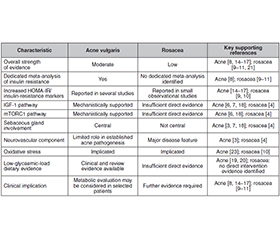
Вульгарне акне та розацеа є поширеними хронічними запальними дерматозами зі складним і багатофакторним патогенезом. Накопичені дані свідчать, що інсулінорезистентність може обумовлювати їх розвиток або клінічні прояви через компенсаторну гіперінсулінемію, зміни сигнального шляху інсуліноподібного фактора росту 1, хронічне низькоінтенсивне запалення, оксидативний стрес й ендотеліальну дисфункцію. У цьому наративному огляді узагальнено сучасні дані щодо взаємозв’язку між інсулінорезистентністю, вульгарним акне та розацеа. Проведено цілеспрямований пошук літератури в базах PubMed/MedLine серед публікацій за період із січня 2016 року до серпня 2026 року. Додаткові релевантні дослідження було виявлено шляхом аналізу списків літератури систематичних оглядів, метааналізів, оригінальних клінічних і механістичних досліджень. Пріоритет надавали публікаціям, присвяченим інсулінорезистентності, гіперінсулінемії, HOMA-IR, інсуліноподібному фактору росту 1, mTORC1, вульгарному акне, розацеа, метаболічним порушенням, оксидативному стресу та дієтичним втручанням. Результати обсерваційних досліджень і метааналізів загалом свідчать про вищі показники інсулінорезистентності в пацієнтів з акне порівняно з контрольною групою. Потенційні механізми включають активацію сигнального шляху PI3K/Akt/mTORC1, посилення андрогенної сигналізації, ліпогенез у сальних залозах, фолікулярну гіперкератинізацію та запальні реакції. Дієтичні втручання з низьким глікемічним навантаженням і терапія, спрямована на поліпшення чутливості до інсуліну, продемонстрували потенційну користь в окремих пацієнтів, хоча наявна доказова база залишається обмеженою. Зв’язок між інсулінорезистентністю та розацеа встановлений менш переконливо. Невеликі дослідження типу «випадок — контроль» виявили підвищену інсулінорезистентність і метаболічні порушення в пацієнтів із розацеа, тоді як дані ширших досліджень кардіометаболічних порушень залишаються неоднозначними. Спільні запальні, оксидативні й судинні механізми забезпечують біологічну правдоподібність такого зв’язку, однак не доводять причинно-наслідкової залежності. Отже, інсулінорезистентність може розглядатися як метаболічна коморбідність або фактор, що модифікує перебіг захворювання, особливо при вульгарному акне. Необхідні проспективні дослідження зі стандартизованою оцінкою метаболічного статусу для уточнення причинно-наслідкових зв’язків і визначення того, чи впливає поліпшення чутливості до інсуліну на дерматологічні результати.
Acne vulgaris and rosacea are common chronic inflammatory dermatoses with complex and multifactorial pathogenesis. Emerging evidence suggests that insulin resistance may contribute to their development or clinical expression through compensatory hyperinsulinemia, altered insulin-like growth factor-1 signalling, chronic low-grade inflammation, oxidative stress, and endothelial dysfunction. This narrative review summarizes current evidence regarding the relationship between insulin resistance, acne vulgaris, and rosacea. A targeted literature search was conducted in PubMed/MEDLINE for publications from January 2016 to August 2026. Additional relevant studies were identified through screening of the reference lists of systematic reviews, meta-analyses, and original clinical and mechanistic studies. Priority was given to publications addressing insulin resistance, hyperinsulinemia, HOMA-IR, insulin-like growth factor-1, mTORC1, acne vulgaris, rosacea, metabolic abnormalities, oxidative stress, and dietary interventions. Observational studies and meta-analytic findings generally indicate higher insulin resistance indices among patients with acne than among controls. Potential mechanisms include activation of the PI3K/Akt/mTORC1 pathway, enhanced androgen signalling, sebaceous lipogenesis, follicular hyperkeratinisation, and inflammatory responses. Low-glycaemic-load dietary interventions and insulin-sensitizing treatment have shown potential benefits in selected patients, although the available evidence remains limited. The association between insulin resistance and rosacea is less clearly established. Small case-control studies have reported increased insulin resistance and metabolic abnormalities in patients with rosacea, whereas evidence from broader cardiometabolic studies remains inconsistent. Shared inflammatory, oxidative, and vascular mechanisms provide biological plausibility but do not establish causality. Insulin resistance may therefore represent a metabolic comorbidity or disease-modifying factor, particularly in acne vulgaris. Prospective studies using standardized metabolic assessments are needed to clarify causal relationships and determine whether improving insulin sensitivity affects dermatological outcomes.
вульгарне акне; розацеа; інсулінорезистентність; інсуліноподібний фактор росту 1; клінічні результати; наративний огляд
acne vulgaris; rosacea; insulin resistance; insulin-like growth factor-1; clinical outcomes; narrative review
Для ознакомления с полным содержанием статьи необходимо оформить подписку на журнал.
- Guguluș DL, Vâță D, Popescu IA, Pătrașcu AI, Halip IA, Mocanu M, et al. The epidemiology of acne in the current era: trends and clinical implications. Cosmetics. 2025;12(3):106. doi: 10.3390/cosmetics12030106.
- Gether L, Overgaard LK, Egeberg A, Thyssen JP. Incidence and prevalence of rosacea: a systematic review and meta-analysis. Br J Dermatol. 2018;179(2):282-289. doi: 10.1111/bjd.16481.
- Clayton RW, Göbel K, Niessen CM, Paus R, van Steensel MAM, Lim X. Homeostasis of the sebaceous gland and mechanisms of acne pathogenesis. Br J Dermatol. 2019;181(4):677-690. doi: 10.1111/bjd.17981.
- Andrusiewicz A, Khimuk S, Mijas D, Shmorhun B, Nowicka D. Molecular mechanisms in the etiopathology of rosacea — systematic review. Int J Mol Sci. 2025;26(23):11292. doi: 10.3390/ijms262311292.
- Pei J, Wang B, Wang D. Current studies on molecular mechanisms of insulin resistance. J Diabetes Res. 2022;2022:1863429. doi: 10.1155/2022/1863429.
- Grafanaki K, Bakoli Sgourou D, Maniatis A, Zouboulis CC. Exposome involvement in the development of acne vulgaris. Front Immunol. 2026;17:1779036. doi: 10.3389/fimmu.2026.1779036.
- Kim H, Moon SY, Sohn MY, Lee WJ. Insulin-like growth factor-1 increases the expression of inflammatory biomarkers and sebum production in cultured sebocytes. Ann Dermatol. 2017;29(1):20-25. doi: 10.5021/ad.2017.29.1.20.
- Nickles MA, Sharma D, Tsoukas MM, Ashack KA. Acne and insulin resistance: a systematic review and meta-analysis. J Am Acad Dermatol. 2022;87(3):687-688. doi: 10.1016/j.jaad.2021.12.033.
- Belli AA, Ozbas Gok S, Akbaba G, Etgu F, Dogan G. The relationship between rosacea and insulin resistance and metabo–lic syndrome. Eur J Dermatol. 2016;26(3):260-264. doi: 10.1684/ejd.2016.2748.
- Demir Pektas S, Cinar N, Pektas G, Akbaba G, Kara A, Hancer HS, et al. Thiol/disulfide homeostasis and its relationship with insulin resistance in patients with rosacea. J Cosmet Dermatol. 2022;21(6):2655-2661. doi: 10.1111/jocd.14477.
- Chen Q, Shi X, Tang Y, Wang B, Xie HF, Shi W, et al. Asso–ciation between rosacea and cardiometabolic disease: a systematic review and meta-analysis. J Am Acad Dermatol. 2020;83(5):1331-1340. doi: 10.1016/j.jaad.2020.04.113.
- Sahoo SS, Madhu SV, Mehndiratta M, Almeida EA, Garg S. Diagnostic tools for insulin resistance: a narrative review. J Diabetol. 2025;16(4):299-307. doi: 10.4103/jod.jod_43_25.
- Di Maio G, Tafuri MG, Casillo M, Messina A, Allocca S, Villano I, et al. Physiological regulation of nutritional and metabolic biomarkers in obesity: implications for precision nutrition. Nutrients. 2026;18(6):1014. doi: 10.3390/nu18061014.
- Nagpal M, De D, Handa S, Pal A, Sachdeva N. Insulin resistance and metabolic syndrome in young men with acne. JAMA Dermatol. 2016;152(4):399-404. doi: 10.1001/jamadermatol.2015.4499.
- Singh M, Shri D. Insulin resistance in moderate to severe acne vulgaris. Indian J Dermatol. 2022;67(2):205. doi: 10.4103/ijd.ijd_396_21.
- Gruszczyńska M, Sadowska-Przytocka A, Szybiak W, Więckowska B, Łącka K. Insulin resistance in patients with acne vulgaris. Biomedicines. 2023;11(8):2294. doi: 10.3390/biomedicines11082294.
- Hasrat NH, Al-Yassen AQ. The relationship between acne vulgaris and insulin resistance. Cureus. 2023;15(1):e34241. doi: 10.7759/cureus.34241.
- Okoro OE, Camera E, Flori E, Ottaviani M. Insulin and the sebaceous gland function. Front Physiol. 2023;14:1252972. doi: 10.3389/fphys.2023.1252972.
- Cebulla P, Czempik E, Wilk H, Turkowska I, Domaszewski P, Chilicka-Hebel K. Glycemic instability and skin health: metabolic mechanisms linking dietary patterns with cutaneous dysfunction. J Clin Med. 2026;15(15):5830. doi: 10.3390/jcm15155830.
- Dessinioti C, Dreno B. Diet and acne: facts and controversies. J Eur Acad Dermatol Venereol. 2026 May 20. doi: 10.1111/jdv.70504.
- Belli AA, Kara A, Ozbas Gok S. Can hematologic parameters be an indicator of metabolic disorders accompanying rosacea? Acta Dermatovenerol Croat. 2017;25(2):145-150. Available from: https://pubmed.ncbi.nlm.nih.gov/28871930/.
- Jin Z, Song Y, He L. A review of skin immune proces–ses in acne. Front Immunol. 2023;14:1324930. doi: 10.3389/fimmu.2023.1324930.
- Kardeh S, Moein SA, Namazi MR, Kardeh B. Evidence for the important role of oxidative stress in the pathogenesis of acne. Galen Med J. 2019;8:e1291. doi: 10.31661/gmj.v0i0.1291.
- Szefler L, Szybiak-Skora W, Sadowska-Przytocka A, Zaba R, Wieckowska B, Lacka K. Metformin therapy for acne vulgaris: a meta-analysis. Pharmaceuticals (Basel). 2024;17(6):728. doi: 10.3390/ph17060728.
- Robinson S, Kwan Z, Tang MM. Metformin as an adjunct therapy for the treatment of moderate to severe acne vulgaris: a randomized open-labeled study. Dermatol Ther. 2019;32(4):e12953. doi: 10.1111/dth.12953.
- Zhu Z, Zhong X, Luo Z, Liu M, Zhang H, Zheng H, et al. Global, regional and national burdens of acne vulgaris in adolescents and young adults aged 10–24 years from 1990 to 2021: a trend analysis. Br J Dermatol. 2025;192(2):228-237. doi: 10.1093/bjd/ljae352.
- Layton AM, Thiboutot D, Tan J. Reviewing the global burden of acne: how could we improve care to reduce the burden? Br J Dermatol. 2021;184(2):219-225. doi: 10.1111/bjd.19477.
- Melnik BC. Acne transcriptomics: fundamentals of acne pathogenesis and isotretinoin treatment. Cells. 2023;12(22):2600. doi: 10.3390/cells12222600.
- Sodagar S, Ghane Y, Heidari A, Heidari N, Khodadust E, Ahmadi SAY, et al. Association between metabolic syndrome and prevalent skin diseases: a systematic review and meta-analysis of case-control studies. Health Sci Rep. 2023;6(9):e1576. doi: 10.1002/hsr2.1576.
- Yaribeygi H, Farrokhi FR, Butler AE, Sahebkar A. Insulin resistance: review of the underlying molecular mechanisms. J Cell Physiol. 2019;234(6):8152-8161. doi: 10.1002/jcp.27603.
- Szukiewicz D. Molecular mechanisms for the vicious cycle between insulin resistance and the inflammatory response in obesity. Int J Mol Sci. 2023;24(12):9818. doi: 10.3390/ijms24129818.
- Baneu P, Văcărescu C, Drăgan SR, Cirin L, Lazăr-Hö–cher AI, Cozgarea A, et al. The triglyceride/HDL ratio as a surrogate biomarker for insulin resistance. Biomedicines. 2024;12(7):1493. doi: 10.3390/biomedicines12071493.
- Srivastava PR, Khare J, Saxena A, Jindal S. Correlation between acne and insulin resistance; experience from central India. J Family Med Prim Care. 2024;13(2):723-725. doi: 10.4103/jfmpc.jfmpc_1232_23.
- Akdağ N, Atli E, Zhuri D, Sezginer Güler H, Gürsel Ürün Y. A study of FoxO1, mTOR, miR-21, miR-29b, and miR-98 expression levels regarding metabolic syndrome in acne vulgaris patients. Cureus. 2024;16(3):e56562. doi: 10.7759/cureus.56562.
- Burris J, Shikany JM, Rietkerk W, Woolf K. A low glycemic index and glycemic load diet decreases insulin-like growth factor-1 among adults with moderate and severe acne: a short-duration, 2-week randomized controlled trial. J Acad Nutr Diet. 2018;118(10):1874-1885. doi: 10.1016/j.jand.2018.02.009.
- Meixiong J, Ricco C, Vasavda C, Ho BK. Diet and acne: a systematic review. JAAD Int. 2022;7:95-112. doi: 10.1016/j.jdin.2022.02.012.
- Kulaklı S, Yıldırmak S, Oğuz ID, Usta M, Aksan B. Eva–luation of atherosclerotic risk in rosacea patients through serum fetuin-A and carotid intima media thickness. J Cosmet Dermatol. 2024;23(3):1075-1084. doi: 10.1111/jocd.16094.
- Caf N, Özkök Akbulut T, Can MM, Sarı M, Atsü AN, Türkoğlu Z. Evaluation of subclinical atherosclerosis in rosacea patients by flow-mediated dilatation method. J Cosmet Dermatol. 2023;22(3):1001-1010. doi: 10.1111/jocd.15492.
- Aksu Çerman A, Kara AE, Aktaş E, Kıvanç Altunay İ. Evaluation of epicardial fat thickness and the ankle-brachial index in patients with rosacea: a case-control study. J Cosmet Dermatol. 2021;20(9):3041-3045. doi: 10.1111/jocd.13997.
- Sharma D, Pagan AD, Caldas SA, Correa da Rosa J, Aninos A, Ungar B. Association between rosacea and increased cardiovascular risk factors: a case-control study using the DataDerm database. JAAD Int. 2024;17:153-154. doi: 10.1016/j.jdin.2024.08.014.
- Su L, Wang F, Wang Y, Qin C, Yang X, Ye J. Circulating biomarkers of oxidative stress in people with acne vulgaris: a systematic review and meta-analysis. Arch Dermatol Res. 2024;316(4):105. doi: 10.1007/s00403-024-02840-5.
- Geng RSQ, Bourkas AN, Sibbald RG, Sibbald C. Biomar–kers in rosacea: a systematic review. J Eur Acad Dermatol Venereol. 2024;38(6):1048-1057. doi: 10.1111/jdv.19732.
- Chen C, Wang P, Zhang L, Liu X, Zhang H, Cao Y, et al. Exploring the pathogenesis and mechanism-targeted treatments of rosacea: previous understanding and updates. Biomedicines. 2023;11(8):2153. doi: 10.3390/biomedicines11082153.
- Hu XM, Li ZX, Zhang DY, Yang YC, Zheng SY, Zhang Q, et al. Current research and clinical trends in rosacea pathogenesis. Heliyon. 2022;8(10):e10874. doi: 10.1016/j.heliyon.2022.e10874.
- Fisher GW, Travers JB, Rohan CA. Rosacea pathogenesis and therapeutics: current treatments and a look at future targets. Front Med (Lausanne). 2023;10:1292722. doi: 10.3389/fmed.2023.1292722.
- AbdElneam AI, Alhajlah S, Al-Dhubaibi MS, Bahaj SS, Mohammed GF, et al. In severe acne vulgaris, TNF-α gene variants are connected to increased TNF-α gene expression and insulin resistance. Skin Res Technol. 2024;30:e13811. doi: 10.1111/srt.13811.
- Sinikumpu SP, Jokelainen J, Tasanen K, Huilaja L. Cardiovascular and metabolic profile of subjects with acne in a cohort of middle-aged patients: a general population study of 1,932 subjects. Acta Derm Venereol. 2023;103:adv5921. doi: 10.2340/actadv.v103.5921.
- Bungau AF, Radu AF, Bungau SG, Vesa CM, Tit DM, Endres LM. Oxidative stress and metabolic syndrome in acne vulgaris: pathogenetic connections and potential role of dietary supplements and phytochemicals. Biomed Pharmacother. 2023;164:115003. doi: 10.1016/j.biopha.2023.115003.
- Ryguła I, Pikiewicz W, Kaminiów K. Impact of diet and nutrition in patients with acne vulgaris. Nutrients. 2024;16(10):1476. doi: 10.3390/nu16101476.
- Guertler A, Neu K, Lill D, Clanner-Engelshofen B, French LE, Reinholz M. Exploring the potential of omega-3 fatty acids in acne patients: a prospective intervention study. J Cosmet Dermatol. 2024;23(10):3295-3304. doi: 10.1111/jocd.16434.
- Telkkälä A, Sinikumpu SP, Huilaja L. Etiology of adult female acne — systematic review. Health Sci Rep. 2025;8(5):e70697. doi: 10.1002/hsr2.70697.
- Zhang J, Yan Y, Jiang P, Liu Z, Liu Y, Liu Y, et al. Association between rosacea and cardiovascular disease: a systematic review and meta-analysis. J Cosmet Dermatol. 2021;20(9):2715-2722. doi: 10.1111/jocd.13884.
- Grafanaki K, Bakoli Sgourou D, Maniatis A, Pasmatzi E. The exposomal imprint on rosacea: more than skin deep. J Eur Acad Dermatol Venereol. 2026;40(3):387-403. doi: 10.1111/jdv.70112.
- Feng Y, Li J, Mo X, Ju Q. Macrophages in acne vulgaris: mediating phagocytosis, inflammation, scar formation, and therapeutic implications. Front Immunol. 2024;15:1355455. doi: 10.3389/fimmu.2024.1355455.
- Juhl CR, Bergholdt HKM, Miller IM, Jemec GBE, Kan–ters JK, Ellervik C. Dairy intake and acne vulgaris: a systematic review and meta-analysis of 78,529 children, adolescents, and young adults. Nutrients. 2018;10(8):1049. doi: 10.3390/nu10081049.
- Morales-Sánchez MA, Camacho-Rosas LH, García-Becerril I, Peralta-Pedrero ML. Effect of adding a low glycemic load and index diet over 12 weeks in the treatment of moderate acne: a randomized controlled trial. Int J Dermatol. 2023;62(1):e39-e42. doi: 10.1111/ijd.16418.
- Nguyen S, Nguyen ML, Roberts WS, Wu M, Smith B, Rahaman T, Nguyen H. The efficacy of metformin as a therapeutic agent in the treatment of acne vulgaris: a systematic review. Cureus. 2024;16(3):e56246. doi: 10.7759/cureus.56246.
- Xia J, Ding L, Liu G. Metabolic syndrome and dermatological diseases: association and treatment. Nutr Metab (Lond). 2025;22(1):36. doi: 10.1186/s12986-025-00924-1.
- Nguyen C, Kuceki G, Birdsall M, Sahni DR, Sahni VN, Hull CM. Rosacea: practical guidance and challenges for clinical management. Clin Cosmet Investig Dermatol. 2024;17:175-190. doi: 10.2147/CCID.S391705.
- Gao X, Xiang W. Efficacy of widely used topical drugs for rosacea: a systematic review and meta-analysis. Actas Dermosifiliogr. 2025;116(8):863-875. doi: 10.1016/j.ad.2024.12.026.