
Інформація призначена тільки для фахівців сфери охорони здоров'я, осіб,
які мають вищу або середню спеціальну медичну освіту.

Підтвердіть, що Ви є фахівцем у сфері охорони здоров'я.

Журнал «Травма» Том 27, №5, 2026

Вернуться к номеру

Порівняльний аналіз напружено-деформованого стану моделі стегнової кістки з ревізійною ніжкою після розширеної проксимальної остеотомії залежно від довжини ніжки
Авторы: Філіпенко В.А., Бондаренко С.Є., Олінкевич Є.В., Марущак О.П., Карпінський М.Ю., Яресько О.В.
ДУ «Інститут патології хребта та суглобів ім. проф. М.І. Ситенка НАМН України», м. Харків, Україна

Рубрики: Травматология и ортопедия

Разделы: Клинические исследования

Версия для печати


Резюме

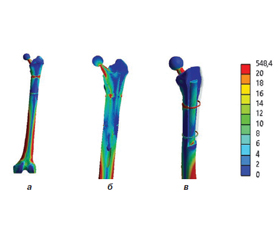
Актуальність. Видалення стабільного стегнового компонента ендопротеза є однією з найскладніших проблем ревізійного ендопротезування кульшового суглоба. Розширена проксимальна остеотомія забезпечує адекватний доступ до каналу стегнової кістки, проте після її виконання постає питання вибору довжини ревізійної ніжки, яка повинна перекрити нижній край остеотомії, не створюючи надмірної концентрації напружень у кістці та фіксуючих елементах. Мета: провести порівняльний аналіз величин напружень у моделі стегнової кістки з ревізійною ніжкою після розширеної проксимальної остеотомії залежно від довжини ніжки. Матеріали та методи. Розроблена базова скінченно-елементна модель стегнової кістки з ревізійним ендопротезом, встановленим після розширеної проксимальної остеотомії. Виготовлено моделі трьох варіантів довжини ніжки ендопротеза: на 1, 3 та 5 см нижче від нижнього краю отвору. Кістковий клапоть фіксували серкляжним дротом діаметром 1,5 мм на двох рівнях по 2 витки. Модель навантажували силою 1100 Н, прикладеною до голівки стегнової кістки, та силою 468 Н з боку абдукторів стегна. Результати. Довжина ніжки ендопротеза практично не впливає на розподіл напружень у кісткових елементах моделей: на дистальному кінці діафіза та в кістковому клапті відмінності між моделями мінімальні. Найбільш значущі зміни спостерігаються в зоні нижнього краю отвору, де зі збільшенням довжини ніжки з 1 до 5 см рівень напружень знижується з 18,9 до 13,0 МПа. Також ніжка, що перекриває нижній край отвору на 5 см, забезпечує найнижчий рівень напружень у шийці ендопротеза (148,9 МПа) та серкляжному дроті (443,9 МПа), проте напруження на її дистальному кінці зростають у 15 разів — до 217,7 МПа, що, однак, у 2,5 раза нижче за межу міцності хірургічної сталі. Висновки. Перекриття нижньої зони остеотомії ревізійною ніжкою на 5 см після видалення стабільного стегнового компонента із застосуванням ETO знижує навантаження на серкляжний дріт і зменшує концентрацію напружень у зоні нижнього краю отвору. Такий вибір довжини ніжки забезпечує стабільність компонентів та має переваги перед використанням коротших ревізійних ніжок, особливо у складних випадках ревізійного ендопротезування.

Background. Removal of a stable femoral component of a prosthesis is one of the most challenging problems in revision hip arthroplasty. An extended trochanteric osteotomy (ETO) provides adequate access to the femoral canal; however, once performed, the question arises as to the choice of length for the revision stem, which must cover the lower edge of the osteotomy without creating excessive stress concentrations in the bone and the fixation elements. The purpose was to conduct a comparative analysis of stress values in a femur model with a revision stem following an ETO, depending on the length of the stem. Materials and methods. A basic finite-element model of the femur was developed with a revision endoprosthesis implanted following an extended proximal osteotomy. Models were created for three variants of the endoprosthesis stem length: 1, 3 and 5 cm below the lower edge of the osteotomy. The bone flap was fixed with a 1.5-mm diameter cerclage wire at two levels, with two turns at each level. The model was loaded with a force of 1100 N applied to the femoral head and a force of 468 N from the hip abductors. Results. The length of the prosthesis stem has virtually no effect on the stress distribution in the bony elements of the models: at the distal end of the diaphysis and in the bone flap, the differences between the models are minimal. The most significant changes are observed in the area of the lower edge of the osteotomy, where, as the stem length increases from 1 to 5 cm, the stress level decreases from 18.9 to 13.0 MPa. Furthermore, a stem that overlaps the lower edge of the osteotomy by 5 cm results in the lowest stress levels in the endoprosthesis neck (148.9 MPa) and the cerclage wire (443.9 MPa); however, the stresses at its distal end increase 15-fold — to 217.7 MPa, which is, nevertheless, 2.5 times lower than the tensile strength of surgical steel. Conclusions. Covering the lower osteotomy zone with a revision stem by 5 cm following the removal of a stable femoral component using an ETO reduces the load on the cerclage wire and decreases stress concentration in the area of the lower edge of the osteotomy. This choice of stem length ensures component stability and offers advantages over the use of shorter revision stems, particularly in complex revision arthroplasty cases.


Ключевые слова

кульшовий суглоб; ревізійне ендопротезування; розширена проксимальна остеотомія; довжина ревізійної ніжки

hip joint; revision arthroplasty; extended trochanteric osteotomy; revision stem length


Для ознакомления с полным содержанием статьи необходимо оформить подписку на журнал.


Список литературы

1. Kksal, A., ner, A., imen, O., Aycan, O.E., Akgn, H., et al. (2020). Femoral stem fractures after primary and revision hip replacements: A single-center experience. Joint Diseases and Related Surgery, 31(3), 557-563. https://doi.org/10.5606/ehc.2020.76162.
2. Abdel, M.P., Wyles, C.C., Viste, A., Perry, K.I., Trousdale, R.T., Berry, D.J. (2021). Extended trochanteric osteotomy in revision total hip arthroplasty: Contemporary outcomes of 612 hips. The Journal of Bone and Joint Surg Am, 103(2), 162-173. doi: 10.2106/JBJS.20.00215.
3. Bondarenko, S.Y., Filipenko, V., Olinkevych, Y., Marushchak, O., Karpinsky, M., Yaresko, O. (2025). Study of the stress-strain state of a femoral model with a revision stem after extended proximal osteotomy depending on the options for fixing the bone flap with a cerclage wire. Trauma, 26(3), 180-188. https://doi.org/10.22141/1608-1706.3.26.2025.1018.
4. Crowninshield, R.D., Brand, R.A., Johnston, R.C., & Milroy, J.C. (1980). An analysis of femoral component stem design in total hip arthroplasty. The Journal of Bone and Joint Surgery. American Volume, 62(1), 68-78. https://doi.org/10.2106/00004623-198062010-00011.
5. Huiskes, R. (1990). The various stress patterns of press-fit, ingrown, and cemented femoral stems. Clinical Orthopaedics and Related Research, 261, 27-38. https://doi.org/10.1097/00003086-199012000-00006.
6. Shimasaki, K., Nishino, T., Yoshizawa, T., Watanabe, R., Hirose, F., Yasunaga, S., et al. (2024). Stress analysis in conversion total hip arthroplasty: A finite element analysis on stem length and distal screw hole. Journal of Clinical Medicine, 14(1), Article 106. https://doi.org/10.3390/jcm14010106.
7. Shimasaki, K., Nishino, T., Yoshizawa, T., Watanabe, R., Hirose, F., Yasunaga, S., et al. (2025). Optimizing stem length in conversion total hip arthroplasty: An expanded finite element analysis. Journal of Clinical Medicine, 14(4), Article 1141. https://doi.org/10.3390/jcm14041141.
8. Huang, Y., Shao, H., Zhou, Y., Gu, J., Tang, H., Yang, D. (2019). Femoral bone remodeling in revision total hip arthroplasty with use of modular compared with monoblock tapered fluted titanium stems: The role of stem length and stiffness. The Journal of Bone and Joint Surgery, 101, 531-538. https://doi.org/10.2106/JBJS.18.00442.
9. Levadnyi, I., Awrejcewicz, J., Goethel, M., Loskutov, A. (2017). Influence of the fixation region of a press-fit hip endoprosthesis on the stress-strain state of the “bone-implant” system. Computers in Biology and Medicine, 84, 195-204. https://doi.org/10.1016/j.compbiomed.2017.03.030.
10. Cowin, S.C. (Ed.). (2001). Bone mechanics handbook. CRC Press.
11. Boccaccio, A., & Pappalettere, C. (2011). Mechanobio–logy of fracture healing: Basic principles and applications in orthodontics and orthopaedics. In V. Klika (Ed.), Theoretical biomechanics.
12. Бондаренко С., Денисенко С., Карпінський М., Яресько О. (2021). Дослідження впливу чашок ендопротезів кульшових суглобів із пористого титану на розподіл напружень у кістковій тканині (математичне моделювання). Травма, 22(3), 28-37. https://doi.org/10.22141/1608-1706.3.22.2021.236320.
13. Berezovskii, V.A., Kolotilov, N.N. (1990). Biophysical characteristics of human tissues: A handbook. Kyiv: Naukova Dumka.
14. Хвисюк О.М., Пустовойт К.Б., Пустовойт Б.А., Карпінський М.Ю., Карпінська О.Д. (2012). Математичне моделювання умов навантаження колінного суглоба у фронтальній площині. Проблеми безперервної медичної освіти та науки, (1), 51-56.
15. Karpinsky, M.Yu., Stroiev, M.Yu., Berezka, M.I., Hryhoruk, V.V., Yaresko, O.V. (2022). The effectiveness of resistance to torsional loads of various options for osteosynthesis of bone fragments of the tibia for fractures in the upper third of the diaphysis (mathe-matical modeling). Orthopaedics, Traumatology and Prosthetics, (3-4), 45-51. https://doi.org/10.15674/0030-598720223-445-51.
16. Вирва О.Є., Головіна Я.О., Малик Р.В., Карпінський М.Ю., Яресько О.В. (2021). Порівняльний аналіз даних напружено-деформованого стану математичних моделей індивідуального ендопротеза й алокомпозитного ендопротеза у разі заміщення дефектів довгих кісток. Травма, 22(4), 37-45. https://doi.org/10.22141/1608-1706.4.22.2021.239708.
17. Вирва О.Є., Головіна Я.О., Карпінський М.Ю., Яресько О.В., Малик Р.В. (2020). Дослідження напружено-деформованого стану в системі «імплантат — кістка» на моделі алокомпозитного ендопротеза проксимального відділу стегнової кістки. Травма, 21(1), 38-48. doi: 10.22141/1608-1706.1.21.2020.197797.
18. Niinomi M. (2008). Mechanical biocompatibilities of titanium alloys for biomedical applications. Journal of the Mechanical Behavior of Biomedical Materials, 1(1), 30-42. https://doi.org/10.1016/j.jmbbm.2007.07.001.
19. Regis, M., Marin, E., Fedrizzi, L., Pressacco, M. (2015). Additive manufacturing of trabecular titanium orthopedic implants. MRS Bulletin, 40, 137-144. https://doi.org/10.1557/mrs.2015.1.
20. Buryanov, O.A., Kvasha, V.P., Chekushyn, D.A., Za–dnichenko, M.O., Karpinsky, M.Yu., Yaresko, O.V. (2024). Ana–lysis of stress distribution in the acromioclavicular joint in case of damage to the conoid ligament and different methods of fixation. Вісник проблем біології і медицини, 3(174), 243-256. https://doi.org/10.29254/2077-4214-2024-3-174-243-256.
21. Kim, J., Chun, B.J., Kim, J.J. (2023). Quantitative load dependency analysis of local trabecular bone microstructure to understand the spatial characteristics in the synthetic proximal femur. Bio–logy, 12(2), Article 170. https://doi.org/10.3390/biology12020170.
22. Kurowski, P. (2019). Engineering analysis with SolidWorks Simulation 2019 Mission: SDC Publications; 606 p.
23. Carreiras, A., Fonseca, E., Martins, D., Couto, R. (2020). The axisymmetric computational study of a femoral component to analysis the effect of titanium alloy and diameter variation. JCAMEH, 51(2), 403-410. https://doi.org/10.22059/jcamech.2020.306191.532.

Вернуться к номеру